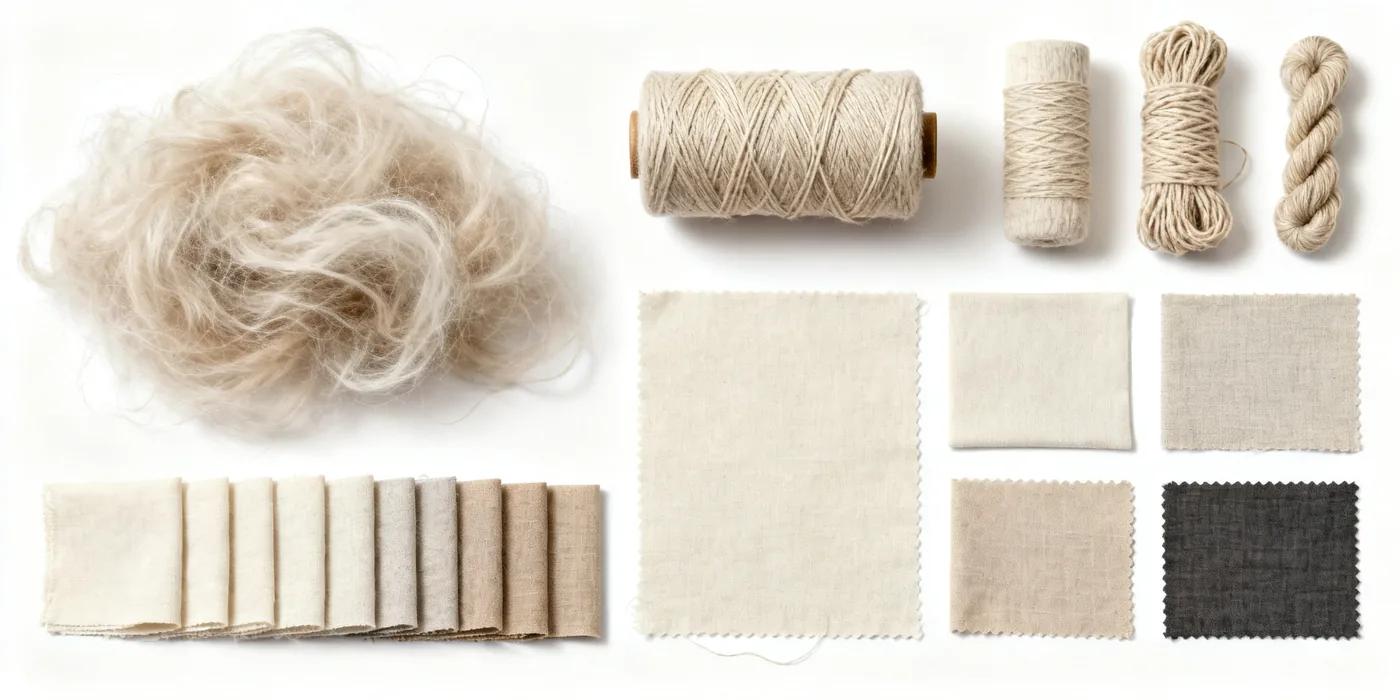
Describe what is physically present
Lenzing is associated with wood-based cellulosic fiber solutions. This material perspective starts with the fiber rather than treating every business activity or brand name as a finished fabric. Modal, viscose and lyocell are useful terms for a development discussion, but the requested fiber grade, blend and supply format still need to be identified. A material name helps locate a family; it does not replace an order specification or define the behavior of a finished textile.
A composition statement describes constituent fibers and their proportions. Linear density describes fineness using a declared unit such as dtex or denier; a yarn count uses its own system and should retain that notation. Supply format tells the next process what material is being discussed. These descriptions work together, while GSM and usable width belong to a fabric stage. Keeping the stages separate prevents a fabric specification from being mistakenly applied to raw fiber.
A tactile sample adds another kind of information. Touch, drape and surface appearance become useful when the reference is identified and the viewing conditions are understood. A soft swatch may result from its yarn structure, knitting and finishing as well as its fiber content. Comparing two differently constructed swatches can suggest directions, but it does not isolate a fiber effect.
Connect language to the intended use
A buyer developing a cellulosic blend needs to connect the desired experience with the process that will create it. State the intended use, care routine and processing sequence. A lightweight jersey worn against the skin poses different questions from a woven home-textile trial. Neither route can be qualified by a fiber name alone. Material comparison becomes more useful when the proposed yarn and construction are visible in the brief.
Natural fibers, regenerated cellulosics and synthetic fibers offer different combinations of handling and processing considerations. Cotton may be a familiar blend reference; a synthetic component may be considered for a different mechanical or drying objective. Assess the complete construction under comparable conditions rather than assigning a universal winner. Likewise, wood origin is a starting point for tracing inputs, not an automatic environmental conclusion.
For a repeatable review, identify the control sample, record the proposed change and retain the test method with its specimen state. A wash comparison should identify the chosen care procedure and report dimensional change separately from surface appearance. A document supporting one fiber or production scope should stay attached to that scope. The aim is a material conversation in which each person can recognize the same specimen and the same next decision.